In the previous posts I was writing about the body’s amazing ability to adapt to physical load and chronic injuries as a result of training load errors. Excessive and rapid increases in training-load are the main cause of non-contact soft-tissue injuries so it is important to monitor and adequately manage the load.
If you don’t want overcomplicate things, just stick to 10% rule. It means to increase load by not more that 10% every following week.
🕵️♂️If you want to know a bit more in depth, carry on reading.
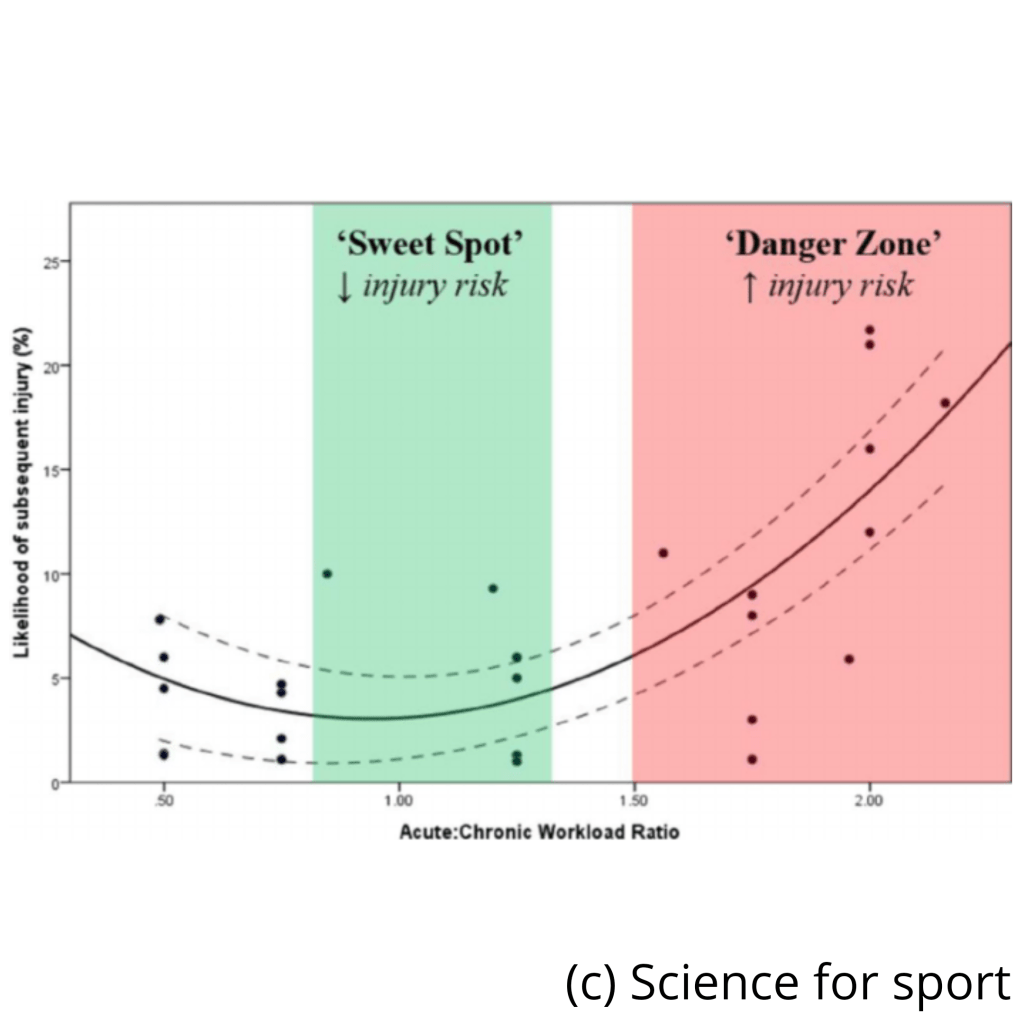
➡️ According to the Acute:Chronic workload ratio theory it is safe to plan the load the next week 0.8-1.30 of the average of previous 3-4 weeks.
🤔 So what is what?
▪️Acute workload is the workload performed by an athlete in 1-week (7 days)
▪️Chronic workload is typically the 4-week (28 day) average acute workload.
▪️Load variables:
– duration
– distance
– frequency
– intensity
– weight
– number of repetitions and other
▪️Example:
Week 1 = 30km
Week 2 = 35km
Week 3 = 30km
Week 4 = 25km
▪️In this case, the 4-week chronic workload value would be the average of these four workloads which is 30km (30+35+30+25 divided by 4)
▪️The ratio itself is calculated by dividing the acute workload by the chronic workload. For example, if the following week is 25km, then the ACWR is 0.83 (25/30).
⚠️There is U-Shape relationship between ACWR and injury risk.
🟡 < 0.80 Under training and higher relative injury risk
🟢 80 – 1.30 Optimal workload and lowest relative injury risk – “The Sweet Spot”
🔴 > 1.50 The “danger zone” and highest relative injury risk
There are two ways of calculating the ACWR, they both have evidence base and pros&cons.
🔎Read more in depth:
https://www.scienceforsport.com/acutechronic-workload-ratio/a
 Wanaka Massage & Pilates, Health coaching with Body Recharge